-%20logo%20(unpadded).png.png)


Cities and towns spend billions of dollars each year maintaining their road networks. Yet many still rely on incomplete or outdated data when making decisions about how to allocate limited infrastructure budgets.
Without consistent and reliable information about road conditions, municipalities often struggle to prioritize repairs effectively. This can lead to wasted spending, deteriorating streets, and growing frustration for residents who deserve safe and reliable transportation networks.
Cyvl was founded to address this challenge by providing cities with scalable, high-quality data about the condition of their infrastructure. Today, the company works with more than 300 municipalities across the United States, Canada, and Australia to help modernize how road networks are monitored and maintained.
To ensure that its pavement assessments remain closely aligned with engineering standards used in the field, Cyvl partnered with the National Center for Asphalt Technology (NCAT) at Auburn University.
Since its founding in 1986, NCAT has been at the forefront of pavement research and is widely recognized as one of the leading authorities in pavement engineering. Its research programs support transportation agencies and infrastructure professionals around the world.
Independent validation from institutions like NCAT plays a critical role in evaluating emerging technologies that aim to improve how infrastructure is managed.
Algorithms aligned with expert engineering standards
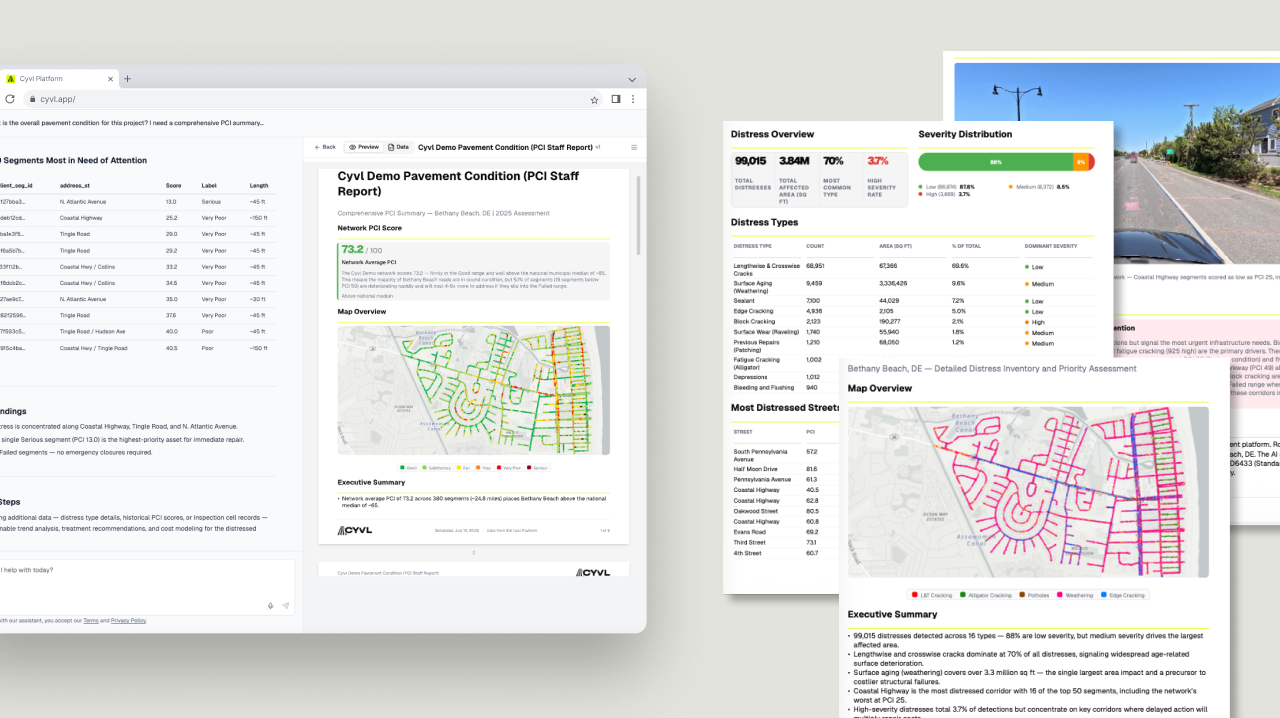
Cyvl’s pavement distress models rely on high-resolution imagery and LiDAR data collected by vehicle-mounted sensors. The models are trained to identify pavement distresses defined under ASTM D6433, the industry standard used to assess pavement condition.
To evaluate the accuracy of these models, NCAT’s pavement experts hand-annotated more than 2,200 images of roadway distresses spanning a wide range of environments, from rural two-lane roads to dense urban networks.
These expert annotations were then compared directly with PCI scores generated by Cyvl’s automated models using rigorous statistical analysis.
The results showed strong agreement between Cyvl’s automated assessments and expert engineering evaluations. On average, Cyvl’s PCI scores differed from expert annotations by just 1.6 points, well within the ±5 tolerance defined by ASTM D6433.
Why cities are moving beyond manual surveying
Manual surveying has long been the standard approach to assessing pavement conditions. However, it is time-consuming, expensive, and inherently subject to human variability.
A peer-reviewed study of municipal inspectors found that human PCI scores can vary by as much as 32 points when evaluating the same pavement section - far exceeding the ±5 tolerance allowed under ASTM standards.
Misclassifying the severity of a pavement distress can lead to costly errors in maintenance decisions. Automated assessments help address these challenges by providing consistent, network-wide data that can be collected quickly and analyzed systematically.
By using vehicle-mounted sensors and artificial intelligence, Cyvl enables cities to assess entire road networks in a fraction of the time required for traditional surveys. This allows municipalities to identify problems earlier, prioritize repairs more effectively, and make better use of limited infrastructure budgets.
As cities increasingly adopt data-driven approaches to infrastructure management, independent validation remains essential to ensure these technologies meet the standards required by engineers and transportation agencies.
Cyvl plans to build on the findings from the NCAT study through targeted model improvements and additional validation using ground-verified pavement surveys, reinforcing its commitment to accuracy, transparency, and engineering rigor. As infrastructure systems age and maintenance needs grow, technologies that provide reliable, scalable insights will play an increasingly important role in helping cities manage their road networks more effectively.
In NCAT's words
"Evaluation of automated PCI results found consistently strong agreement with our expert annotations, with differences typically within industry‑recognized tolerances. These outcomes illustrate how closely automated scoring can mirror traditional engineering assessments in real‑world settings."
—Adriana Vargas-Nordcbeck, Ph.D., Associate Research Professor, National Center for Asphalt Technology
Easy steps to create a color palette
Lorem ipsum dolor sit amet, consectetur adipiscing elit lobortis arcu enim urna adipiscing praesent velit viverra sit semper lorem eu cursus vel hendrerit elementum morbi curabitur etiam nibh justo, lorem aliquet donec sed sit mi dignissim at ante massa mattis.
- Neque sodales ut etiam sit amet nisl purus non tellus orci ac auctor
- Adipiscing elit ut aliquam purus sit amet viverra suspendisse potent
- Mauris commodo quis imperdiet massa tincidunt nunc pulvinar
- Excepteur sint occaecat cupidatat non proident sunt in culpa qui officia
What is a color palette?
Vitae congue eu consequat ac felis placerat vestibulum lectus mauris ultrices cursus sit amet dictum sit amet justo donec enim diam porttitor lacus luctus accumsan tortor posuere praesent tristique magna sit amet purus gravida quis blandit turpis.

Don’t overspend on growth marketing without good retention rates
At risus viverra adipiscing at in tellus integer feugiat nisl pretium fusce id velit ut tortor sagittis orci a scelerisque purus semper eget at lectus urna duis convallis porta nibh venenatis cras sed felis eget neque laoreet suspendisse interdum consectetur libero id faucibus nisl donec pretium vulputate sapien nec sagittis aliquam nunc lobortis mattis aliquam faucibus purus in.
- Neque sodales ut etiam sit amet nisl purus non tellus orci ac auctor
- Adipiscing elit ut aliquam purus sit amet viverra suspendisse potenti
- Mauris commodo quis imperdiet massa tincidunt nunc pulvinar
- Adipiscing elit ut aliquam purus sit amet viverra suspendisse potenti
What’s the ideal customer retention rate?
Nisi quis eleifend quam adipiscing vitae aliquet bibendum enim facilisis gravida neque euismod in pellentesque massa placerat volutpat lacus laoreet non curabitur gravida odio aenean sed adipiscing diam donec adipiscing tristique risus amet est placerat in egestas erat.
“Lorem ipsum dolor sit amet consectetur adipiscing elit, sed do eiusmod tempor incididunt ut labore et dolore magna aliqua enim ad minim veniam.”
Next steps to increase your customer retention
Eget lorem dolor sed viverra ipsum nunc aliquet bibendum felis donec et odio pellentesque diam volutpat commodo sed egestas aliquam sem fringilla ut morbi tincidunt augue interdum velit euismod eu tincidunt tortor aliquam nulla facilisi aenean sed adipiscing diam donec adipiscing ut lectus arcu bibendum at varius vel pharetra nibh venenatis cras sed felis eget.